

E. E. Cummings
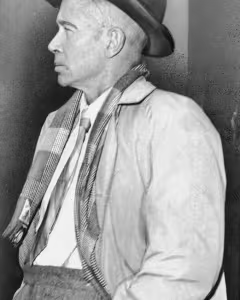
E.E. Cummings (1894-1962) is a poet beloved for his unpretentious, irreverent, and rule-breaking approach to modernism.
Cummings was born in Cambridge, Mass. and educated at Harvard (1911-1916), spending four years in undergraduate study followed by one year as a Masters student. In 1917, during the Great War, he volunteered as an ambulance driver in France. After three months at the Front, he and his friend, William Slater Brown, were arrested on account of frank letters written by Brown concerning atrocities of war, the demoralization of the French soldiers, and other topics displeasing to the French censors. Cummings and Brown were deemed “undesirable in the war zone” and incarcerated in a detainment centre at La Ferté-Macé: Cummings later recounted these experiences in his first work of prose, The Enormous Room (1922). In the following year, Thomas Seltzer published Cummings’s first solo collection of poetry: Tulips and Chimneys (1923). (Seltzer stripped more than half of the poems from the manuscript and altered the title; the preferred text is now Tulips & Chimneys (1922 ms), which restores Cummings’s cherished ampersand along with the rejected poems.…
Image: Library of Congress Prints and Photographs Division. New York World-Telegram and the Sun Newspaper Photograph Collection. No known copyright restrictions.
Subscribe to E. E. Cummings
via RSS
| # | Resource Title | Description | Contributor |
|---|---|---|---|
| 1 | E.E. Cummings: A Pagan Modernist | Alison Rosenblitt | |
| 2 | E.E. Cummings | E.E. Cummings (1894-1962) is a poet beloved for his unpretentious, irreverent, and rule-breaking… |
Alison Rosenblitt |