
Charles Dickens
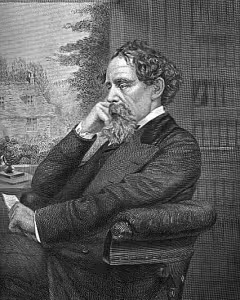
Charles Dickens [Public domain] via Wikimedia Commons
In some ways, it is extremely difficult to pin down what makes Charles Dickens (1812-1870) a great writer. With a career than ran from 1836 to 1870, from Sketches by Boz to the unfinished novel The Mystery of Edwin Drood, Dickens is the acknowledged master of the Victorian novel, sometimes considered second only to Shakespeare among the ranks of English language authors. But what makes him great? Why did he transcend his own century and find his way into so many aspects of contemporary popular culture?
As a way of perhaps narrowing the field, let us consider, for a moment, what weaknesses one might find in Dickens.
First of all, we might acknowledge his tendency to rely on coincidence. For instance, Oliver Twist ends entirely too neatly (but we wouldn't dream of giving it away). Also, Dickens' more sentimental aspects have not aged well. Of The Old Curiosity Shop, Oscar Wilde quipped, 'One would have to have a heart of stone to read the death of little Nell without dissolving into tears…of laughter.' Dickens also has an unfortunate tendency to write very good, very beautiful, very dull heroines: Agnes in…
Subscribe to Charles Dickens
via RSS
| # | Resource Title | Description | Contributor |
|---|---|---|---|
| 41 | Hard Times | Lond. &c. 1908 Series: Nelson's sixpenny classics 28 Lond. &c. 1908 Series: Nelson's… | |
| 42 | The Mystery of Edwin Drood, and Some Uncollected Pieces | Boston: Fields, Osgood & Co. 1870 | |
| 43 | The Pic-nic Papers | London; Ward. Lock & Co. 1882 | |
| 44 | Why Dickens? | Dr Robert Douglas-Fairhurst talks of Dickens' life and influences and why these have made his works… | Robert Douglas-Fairhurst |