William Shakespeare
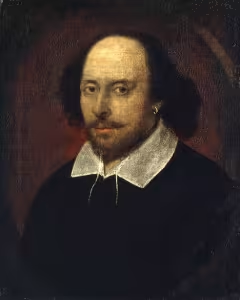
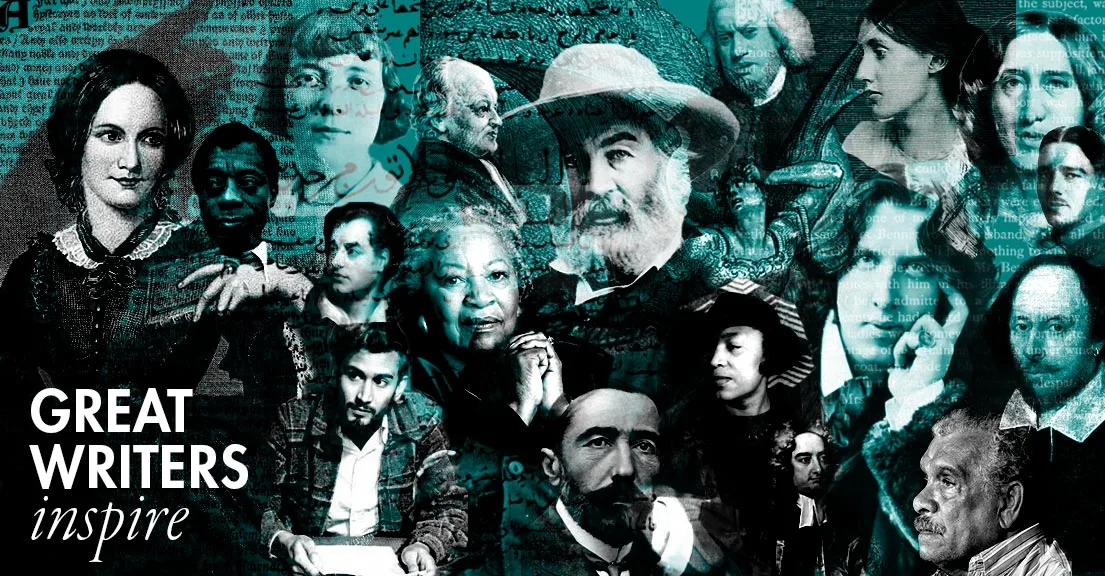
How William Shakespeare (1564-1616), son of a provincial glover, became the world's most famous literary icon, is a story that's been told many times. Our appetite for biographies of Shakespeare is apparently insatiable: new lives of Shakespeare are always being written, as if we are still trying to find the key to understand the operation of his genius and the source of his literary immortality. This Great Writers theme focuses on the works themselves, with lectures, ebooks, and supporting material to find new angles and sources of critical analysis and enjoyment.
The biographical facts of Shakespeare's life can be easily recounted. He was born in Stratford-upon-Avon, a market town in the English midlands, in 1564: his father was a glover. We know little about his education but he almost certainly attended the town grammar school where he would have learned the standard Latin literary and rhetorical curriculum: we see some Elizabethan classroom staples in The Merry Wives of Windsor. There is no record of Shakespeare having attended university. He married Anne Hathaway in 1582, and their daughter Susanna was born in 1583, followed by twins Hamnet and Judith in…
Subscribe to William Shakespeare
via RSS
| # | Resource Title | Description | Contributor |
|---|---|---|---|
| 71 | Acting Masterclass: "Lend me your ears" | A practical Masterclass with Greg Doran from the Royal Shakespeare Company on how Shakespeare spins… | Gregory Doran, Sam Leith |
| 72 | Acting Masterclass: 'Pyramus, you begin' | A practical Masterclass looking at what clues Shakespeare puts into the verse for the actor.… | Gregory Doran |
| 73 | Acting Masterclass: 'Pyramus, you begin' | A practical Masterclass with Greg Doran from the Royal Shakespeare Company looking at what clues… | Gregory Doran |
| 74 | The Merchant of Venice | This lecture on The Merchant of Venice discusses the ways the play's personal relationships are… | Emma Smith |
| 75 | Taming of the Shrew | Emma Smith uses evidence of early reception and from more recent productions to discuss the… | Emma Smith |
| 76 | A Midsummer Night's Dream | This lecture on A Midsummer Night's Dream uses modern and early modern understandings of dreams to… | Emma Smith |
| 77 | Much Ado About Nothing | Emma Smith asks why the characters are so quick to believe the self-proclaimed villain Don John,… | Emma Smith |
| 78 | Hamlet | The fact that father and son share the same name in Hamlet is used to investigate the play's… | Emma Smith |
| 79 | As You Like It | Asking 'what happens in As You Like It', this lecture considers the play's dramatic structure and… | Emma Smith |
| 80 | The language of Shakespeare | Actors and the director talk about how they have approached and worked with their student… | Kate O'Connor |